
the 4 signals of economically scalable demand
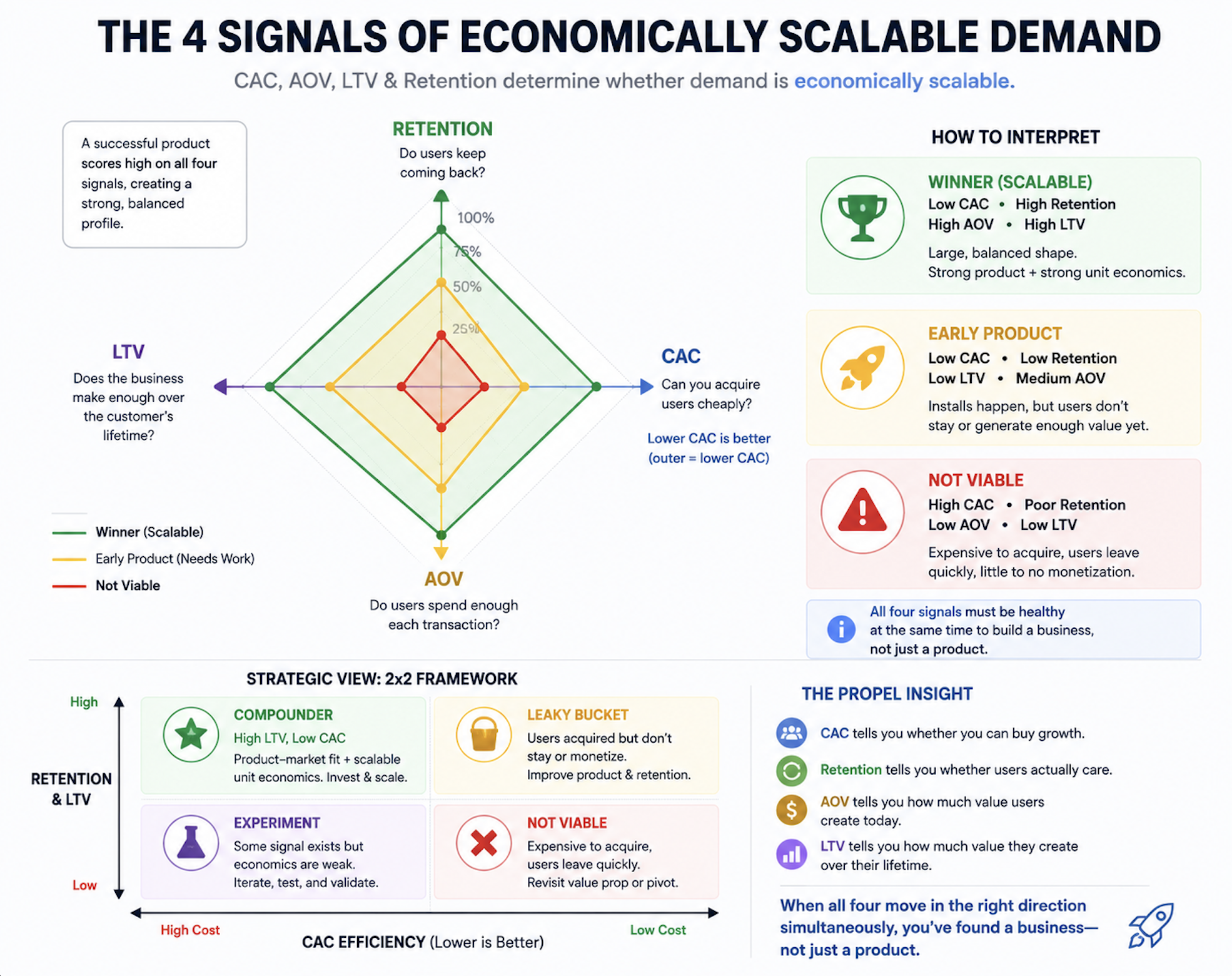
i keep coming back to the same four questions whenever i look at a consumer product:
CAC → can you acquire users cheaply?
Retention → do users actually keep coming back?
AOV → do users spend enough each transaction?
LTV → does the business make enough over the customer’s lifetime?
that’s it; most of the noise around “demand” collapses into these.
huge demand with terrible unit economics isn’t a great business; low retention or weak LTV will eat you alive no matter how many installs you rack up. the reverse is also true — the companies that feel inevitable usually score well on all four at once.
why a radar chart
people default to X–Y graphs for this kind of thing; i don’t love that here. these four signals aren’t two pairs competing for space — each one matters on its own; each one pulls equal weight.
so i prefer a 4-axis radar (spider) chart.
one nuance on CAC: invert the axis. closer to the center means higher CAC; farther out means lower CAC. lower CAC is better, so the “good” direction should match the other axes visually; otherwise the chart lies to your eye.
how to read it
Winner — low CAC, high retention, high AOV, high LTV. the polygon is large and almost symmetric. product works; economics work. you can push.
Early product — CAC looks fine (curiosity drives installs), but retention and LTV are weak; AOV is maybe mid. the shape skews. marketing is doing its job; the product hasn’t earned the right to keep people yet.
Not viable — high CAC, poor retention, low AOV, low LTV. tiny blob near the center. expensive to acquire, quick to leave, not much monetization; hard to argue you’re looking at a business.
what each number is actually telling you
every consumer product, stripped down, is these four numbers:
- CAC tells you whether you can buy growth.
- Retention tells you whether users actually care.
- AOV tells you how much value users create today.
- LTV tells you how much value they create over their lifetime.
you can win a week on one of them; you can even fake momentum for a quarter. but when all four move in the right direction at the same time — that’s when you’ve found a business, not just a product.