
consumer apps are becoming digital DTC brands
everyone in consumer tech is obsessed with lowering CPI. or lowering CAC. or improving ROAS.
every meeting somehow comes back to acquisition. can we get cheaper installs? can we improve click-through rates? can we reduce our CPP by 10%?
but i’ve been thinking about something else lately.
a few days ago i came across a post on how DTC brands think about increasing AOV. the idea was simple: instead of trying to acquire more customers, make every customer worth more.
that got me thinking — isn’t that exactly what consumer subscription apps should be doing too? not by increasing AOV, but by increasing LTV.
we borrowed the wrong lessons
i think we’ve been copying the wrong parts of ecommerce. everyone took Meta ads, creative testing, and landing pages; very few copied how DTC companies think about monetization.
and i think that’s where the opportunity is.
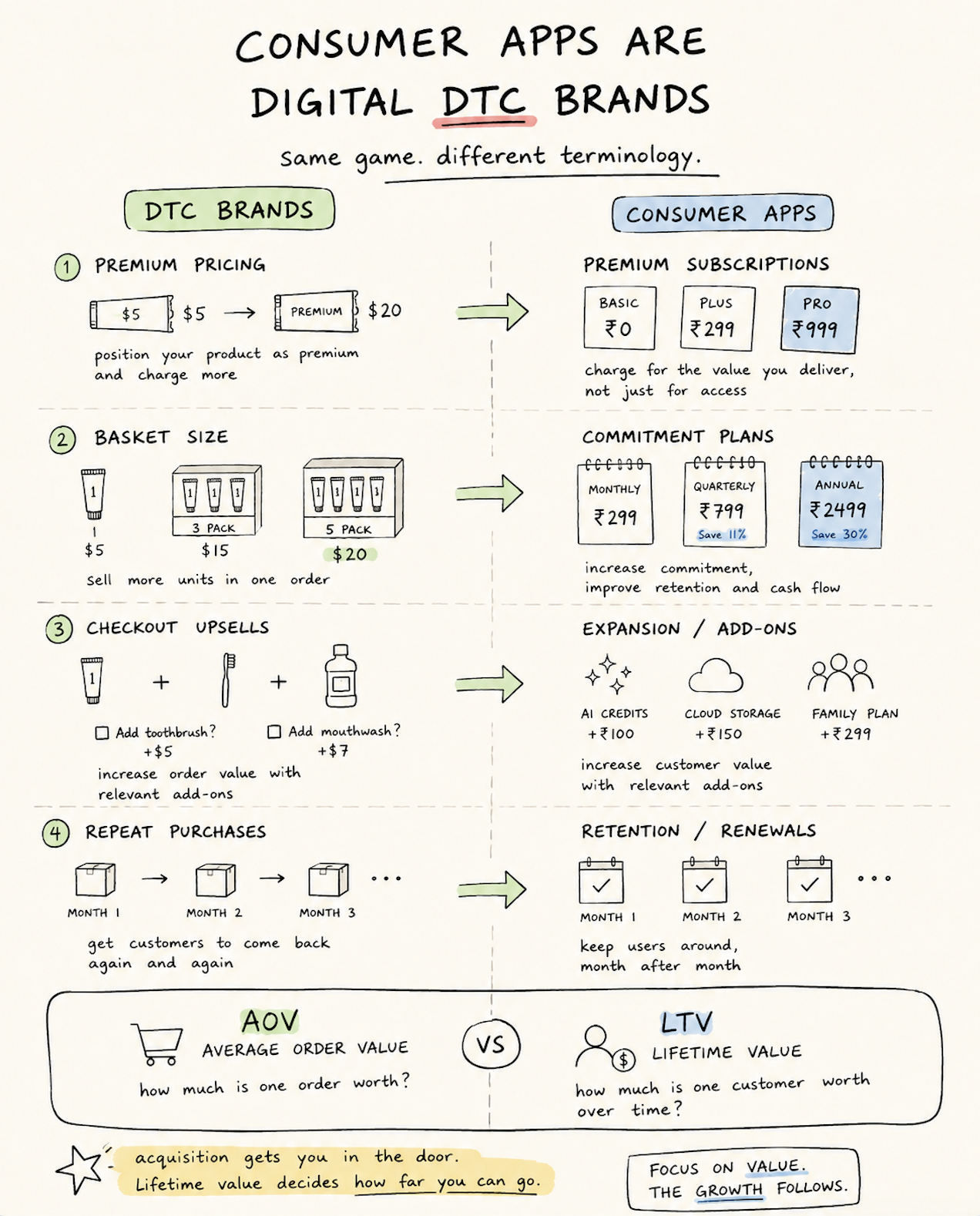
toothpaste, then apps
take a toothpaste. it sells for $5.
a typical founder thinks: great, let’s sell more toothpaste.
a DTC founder thinks differently.
first — can i position this as a premium product and charge $20 instead?
second — can i sell 3 or 5 tubes instead of one?
third — can i get the customer to add a toothbrush or mouthwash before checkout?
finally — once i’ve squeezed most of the value from the first order, how do i get this customer to come back?
none of these ideas are about acquisition. they’re about increasing the value of a customer you’ve already paid to acquire.
now replace toothpaste with a consumer app; the parallels get obvious.
premium pricing becomes premium subscriptions.
multi-packs become monthly, quarterly, and annual plans.
checkout upsells become AI credits, premium features, cloud storage, family plans — whatever fits the product.
repeat purchases become renewals.
AOV becomes LTV. same game; different terminology.
the CPI vs retention trade
this is where a lot of consumer apps leave money on the table.
a team spends months reducing CPI from ₹18 to ₹16. another team spends months improving day-30 retention from 18% to 24%.
which one wins? almost always the second.
every retained customer increases how much you can spend on acquisition tomorrow. retention doesn’t just improve revenue; it changes your entire growth equation.
most apps sell one tube forever
another thing i’ve noticed: most consumer apps only think about one purchase — the monthly subscription.
that’s equivalent to a DTC brand selling a single toothpaste tube forever. why stop there?
if someone believes in your product, why not offer an annual plan? a family plan? usage-based add-ons? premium content? an AI tier?
software is probably the only industry where your product can keep becoming more valuable after someone has already paid. physical products don’t get that luxury.
expansion revenue
there’s another advantage consumer apps have: expansion revenue.
a toothpaste company has to convince you to buy something else. software can convince you to become a bigger customer.
free → plus → pro → team → enterprise.
the customer never leaves your ecosystem; they simply keep increasing in value. that’s a beautiful business model if you get it right.
we measure the wrong things
we celebrate lower CPI. higher CTR. better install rates.
those metrics matter; they’re not the business. the business is expected lifetime value.
if two apps have the same CPI, but one retains users for twelve months while the other retains them for three, they are not remotely comparable businesses. one can outbid everyone forever; the other eventually hits a wall.
the simple frame
the way i think about consumer apps now is pretty simple:
- acquisition gets users through the door
- activation helps them experience value
- conversion gets them to pay
- retention keeps them around
- expansion increases what they’re worth
every one of those stages compounds; every improvement makes the next stage more valuable.
the mindset shift
i think consumer tech is going to look a lot more like modern DTC over the next few years. not because apps will start selling bundles — because the mindset is changing.
the question is no longer: how do i get another customer?
the question is: how do i make every customer i already have worth more?
that’s a much harder problem; it’s also a much better business.
the best consumer companies won’t necessarily be the ones with the cheapest acquisition. they’ll be the ones that build systems to continuously increase customer value over time.
that’s the lesson consumer tech should borrow from DTC — not their ad strategies, not their creative frameworks.
their obsession with making every acquired customer more valuable than the last.